
How to Choose Industrial Chairs for Every Room
Industrial chairs have a way of making a room feel grounded. The first time I slid a blackened-steel dining chair up to a reclaimed oak table, the whole space tightened up — suddenly there was texture, history, and a quiet confidence that a perfectly matched set could never deliver. That is the pull of industrial seating: it borrows the honesty of the factory floor and translates it for the way we actually live.
But "industrial chair" is a much broader category than most people realize. The same design DNA — exposed metal, raw materials, function-first construction — shows up in a swivel task chair at your desk, a curved-back seat at your dinner table, and a barrel accent chair tucked into a reading corner. Each room asks something different from a chair, and the wrong pick is almost always a mismatch between what the chair needs to do and how it looks doing it.
This guide walks through how to choose industrial chairs room by room. I'll cover what actually defines the look, the three chair types that matter most for a home, the materials behind them, and the sizing and styling details that separate a chair that lands from one that just sits there.

1. What Is an Industrial Chair?
An industrial chair is, at its core, a piece of seating that takes its cues from old factories, workshops, and warehouses[1]. Where traditional furniture hides its construction, industrial furniture celebrates it. You see the welds, the bolts, the grain of the metal, the stitching of the leather. Nothing is dressed up to look like something it isn't.
Five traits tend to show up together, and in my experience you want at least three of them before a chair genuinely reads as industrial:
- Raw or exposed materials — steel, iron, aluminum, reclaimed wood, concrete, and leather that's allowed to age.
- Visible construction — rivets, bolts, exposed welds, and frames left bare rather than boxed in.
- A muted, material-first palette — blacks, grays, browns, and metallic tones, with color coming from the material itself rather than paint[4].
- Clean, structural lines — minimal curves for decoration; curves exist for ergonomics, not ornament.
- Function over flourish — every element earns its place by doing a job.
The style grew out of mid-twentieth-century conversions — artists and designers moving into disused industrial spaces and furnishing them with the very objects those spaces had produced[1]. What began as necessity became an aesthetic, and today the look reads as both rugged and deliberately composed. A well-chosen industrial chair carries that dual nature: it looks like it has worked for a living, but it's placed with care.
2. Why Industrial Chairs Belong in Every Room
The reason I keep coming back to industrial chairs is their range. Unlike a delicate Louis-style accent chair or a strictly mid-century piece, industrial seating doesn't belong to one room. The same chair can anchor a home office in the morning and frame a dining table in the evening, because its identity comes from materials and construction rather than a single decorative tradition.
There's also a practical sturdiness to the style. Metal frames and leather or wood seats are built to take daily use, which makes them genuinely livable for households that actually use their furniture. I've found that industrial pieces tend to age outwardly — a leather seat softens, a steel frame develops a quiet patina — and that aging reads as character rather than wear. You're not fighting to keep them looking new.
Finally, industrial chairs play well with other styles. Set against soft textiles, warm wood, or even polished stone, their rawness becomes a counterpoint that sharpens everything around it. That contrast is the secret to why a single industrial chair can make a whole room feel more intentional.
Once you start thinking in whole rooms rather than single chairs, the next question is how an industrial chair fits the larger composition — the sofa, the table, the shelving around it. For that wider view, our guide on furnishing a living room with industrial furniture walks through the full room, and our guide to choosing an industrial sofa covers the seating piece that anchors it.
3. Types of Industrial Chairs by Room
This is where most buying guides go wrong: they treat "industrial chair" as one thing. In practice, the category splits cleanly by what a chair is asked to do, and the room it serves largely decides the type. The three types below cover the vast majority of homes, and each lines up with a different space.
3.1. Industrial Office Chairs
Industrial office chairs descend from the task chairs and drafting stools used in factories and workshops, where a worker needed to swivel, roll, and adjust height through a long shift[5]. That heritage shows up in three features that still define the type today: a swivel base, height adjustment (traditionally a gas lift), and a metal frame paired with leather, distressed wood, or molded plywood. The wing-back silhouette in particular pulls from executive leather seating, giving you workshop construction with a more commanding presence at a desk.
If you're sizing an industrial office chair, two numbers matter more than anything else: seat height range and back height. A chair that can't reach your desk height will fight you all day, and a back that stops at the shoulder blades feels very different from a wing-back that frames your head. Look for a swivel mechanism that locks in place — the factory originals were built to stay put under load, and the best modern versions keep that stability.
For a grounded, classic look, a brown leather wing-back on a metal base reads as an executive workshop chair — warm, serious, and quietly confident in a home office.
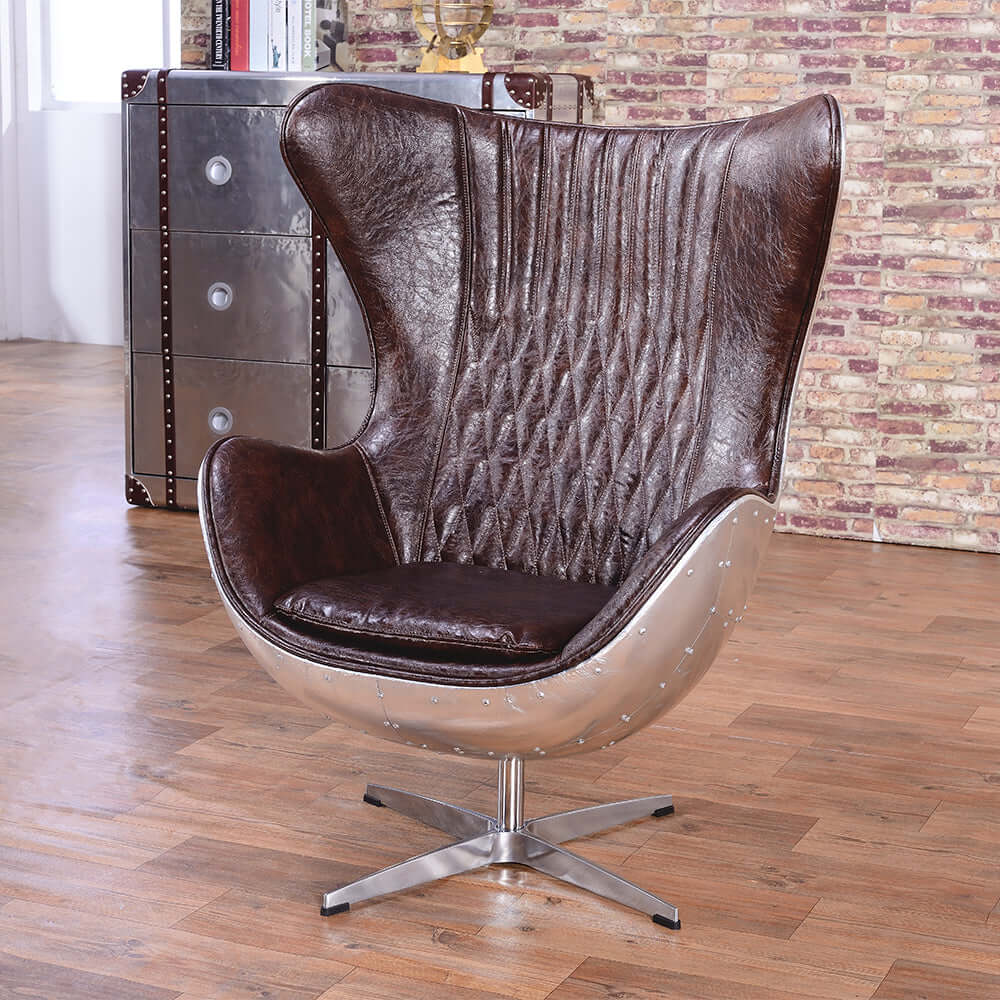
Brown & Silver Wing-Back Leather Office Chair
- Wing-back profile upholstered in leather for an executive workshop look
- Brown and silver finish pairing for authentic industrial contrast
- Swivel task-chair base for easy movement around your workspace
If you'd rather your desk chair make a statement, a national-flag leather upholstery turns the same wing-back task silhouette into a personal piece. It keeps the industrial-style frame and swivel heritage while letting the leather do the talking — a good option for a creative workspace where the chair is meant to be noticed, not disappeared into the background.
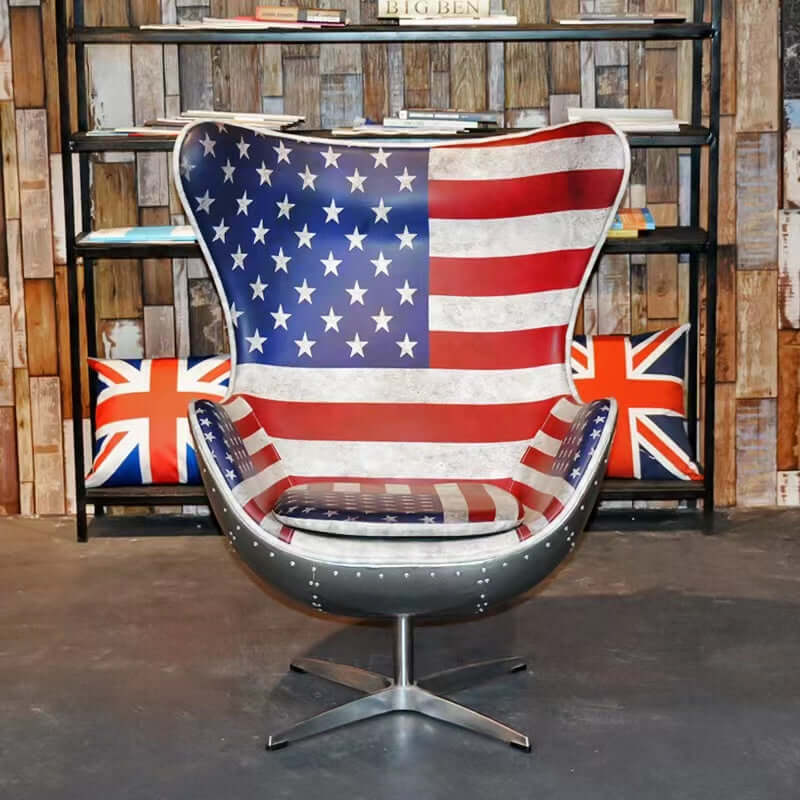
National Flag Industrial Wing-Back Office Chair
- National-flag leather upholstery for a bold personal statement
- Wing-back task-chair silhouette with industrial-style heritage
- Swivel base for fluid movement between tasks
3.2. Industrial Dining Chairs
Industrial dining chairs take a different route. Where the office version is about movement and adjustability, the dining version is about a stable, stationary silhouette inspired by café, bistro, and factory-canteen seating[5]. Think fixed legs rather than wheels, a frame built to be tucked under a table, and an emphasis on visual presence over all-day comfort. They're designed for the duration of a meal and the look of a room, not an eight-hour sit.
The archetype here is the Tolix-style metal chair and the wood-and-metal cross-back, but a modern industrial dining chair more often blends a metal frame with an upholstered seat and back. That blend is what makes the style so useful at a table: you get the raw frame for character and a curved, padded back for actual comfort when guests linger. Among the industrial sub-types, dining chairs are also where the field is least crowded, which makes them one of the easier entries for a home looking to build the look without competing for the same attention every other buyer is chasing.
When you're sizing a set, chair width and seat height are the numbers to hold to. A typical dining chair runs about 17–19 inches of seat height to clear a standard 30-inch table, and you'll want roughly 24 inches of width per setting so elbows have room. If you're working with a round table, the same height rules apply but the arc changes the math on how many chairs fit comfortably — a detail worth a separate look if that's your layout. For a straightforward rectangular table, a set of two curved-back chairs in gray metal and brown upholstery is a fast, reliable way to build the look around your existing surface.

Industrial Gray & Brown Dining Chairs (Set of 2)
- Hardwood seat paired with an industrial-gray metal frame for a retro look
- Ergonomic curved backrest upholstered in PU leather for everyday comfort
- Sold as a set of two to anchor a dining table instantly
For more on seating proportions at a round table, our guide on how to choose dining chairs for a round table breaks down seat height, chair width, and visual weight balance.
3.3. Industrial Accent Chairs
Industrial accent chairs are the expressive wing of the family. Freed from the duty of desk work or dinner, an accent chair's job is to add presence to a corner — a reading nook, the foot of a bed, a gap in the living room. Because they're bought for looks as much as use, this is where industrial design leans into silhouette: barrel shapes, club-chair curves, and the kind of profiles that read as sculpture when they're empty.
The barrel chair is the standout here, and it's one of the most searched seating silhouettes for a reason — the curved, wraparound back is immediately recognizable and reads as both traditional and industrial depending on the frame and upholstery. A barrel chair in PU leather with nail-head trim pulls from Chesterfield styling, and when you set that traditionally upholstered shell on an industrial metal or wood frame, the contrast is the whole point. It's a chair that can hold its own in the middle of a room.
Sizing an accent chair is less about ergonomics and more about footprint. Measure the corner or wall it's meant for, and check both the chair's overall width and its depth when you're sitting in it — a barrel silhouette can surprise you with how far forward it reaches. If you're pairing it with upholstered seating in softer materials, our notes on choosing an accent chair cover how to balance a statement piece against the room around it.
Industrial Loft Black Barrel Accent Chair
- Chesterfield-inspired barrel silhouette in PU leather with nail-head trim
- Aluminum frame blending traditional refinement with industrial-loft edge
- Sturdy 551 lb weight capacity for a confident statement seat
3.4. Industrial Armchairs and Lounge Chairs
Beyond the three main types, industrial design shows up in armchairs and lounge chairs built for longer, lazier sits. These tend to be larger and more padded — pillow-back armchairs with faux-leather upholstery, wide lounge chairs pairing solid wood frames with metal accents. They're the right call when you want the industrial material language in a piece that's genuinely made for sinking into, whether that's a living-room anchor or a statement seat in a study. If a dining chair is too upright and an office chair too task-focused, the industrial armchair is the middle ground.
4. Materials That Define the Industrial Look
Strip the style down and industrial chairs are really a material story. The look lives in three material families, and understanding them tells you both how a chair will age and how it will read in your room.

4.1. Steel and Iron Frames
Steel and iron are the structural backbone of the style — this is where the "industrial" in the name literally comes from. Galvanized or powder-coated steel resists rust and gives the clean, matte finish most associated with the look[2], while cast iron brings weight and a more vintage, factory-floor character[3]. A powder-coated frame is the more practical choice for a home: it's smooth to the touch, easy to wipe down, and holds its finish for years. For a deeper look at how steel frames shape a chair's entire personality, our piece on stainless steel frame chairs walks through how metal construction changes everything from seat comfort to visual weight.
4.2. Leather and PU Upholstery
Leather is what softens industrial seating and makes it livable. Distressed genuine leather ages into a patina that suits the raw frame beneath it, while PU leather offers the same look with easier maintenance and consistent finish — useful in a dining chair that sees regular use. Nail-head trim, tufting, and wing-back profiles all come from the upholstery side of the family and are what let a single metal-framed chair read as anything from factory stark to executive refined. If you want to go deep on leather seating characteristics, our guide to leather chairs covers the material in detail.
4.3. Reclaimed Wood and Metal Combinations
The third material pillar is wood — specifically, the combination of reclaimed or distressed timber with a metal frame. This pairing is arguably the most recognizable industrial look: warm wood seat or backrest set against a cool steel frame, the two materials doing exactly what they're best at. Hardwood brings warmth and a slightly retro feel, and when it's left with visible grain and paired with an industrial-gray or black metal frame, the chair reads as both rugged and homely. It's the combination I reach for most often in dining settings, where pure metal can feel cold over a long meal.
5. How to Choose the Right Industrial Chair
Once you know the types and materials, the actual choosing comes down to matching a chair to the job it needs to do. I use a short checklist that works whether you're buying one chair or furnishing a whole room.
5.1. Seat Height and Intended Use
Start with seat height, because it's the one number that can make a chair unusable. A dining or accent chair around 17–19 inches of seat height works for standard tables and general seating. An office chair needs an adjustable range that reaches your desk — typically starting around 16 inches and rising to 21 or more. Before anything else, confirm the chair's seat height suits what you'll do in it; a beautiful chair at the wrong height is just an obstacle.
5.2. Comfort Versus Statement
Next, be honest about the balance you're chasing. A dining chair can afford to be firmer and more visually driven because nobody sits in it for five hours. An office chair or lounge chair needs real ergonomic support — a back that follows your spine, a seat that doesn't go numb after an hour. Accent chairs live in between: they should look like a statement but still be tolerable for a book or a conversation. Decide where on that spectrum the chair needs to land before you fall for a silhouette.
5.3. Mixing Industrial Chairs With Other Styles
Finally, think about how the chair fits what you already own. Industrial chairs are unusually good at mixing, but there's a logic to it. Pair a raw metal-and-leather chair with softer textiles and warm wood to let its roughness sharpen the room, or cluster several industrial chairs together for a deliberate, cohesive zone. The mistake to avoid is dropping one industrial chair into a room of delicate, ornate pieces and expecting it to blend — it won't, and it isn't supposed to. Its job is to be the grounding element.
6. Styling Tips for Industrial Chairs
Styling industrial chairs is mostly about contrast and restraint. Let the materials do the talking: a steel-framed leather chair doesn't need busy surroundings, it needs space and a counterpoint. Concrete, brick, or limewashed walls give industrial seating the texture it was born to sit against, while a soft rug underneath stops the look from feeling cold. I prefer to keep the area around a strong industrial chair relatively quiet — one or two material companions rather than a crowd — so the chair's construction stays visible.
Color is the other lever. Because industrial chairs lean on blacks, grays, browns, and metallics, you can use the surrounding textiles to introduce warmth or a single accent tone. A cushion, a throw, or a nearby piece of upholstered furniture in a warmer palette will pull the brown out of a leather seat and tie the chair into the rest of the room. For a fuller framework on balancing a statement seat against upholstered pieces, our guide to pairing sofas and accent chairs covers the color and weight principles that apply here.
FAQ
What makes a chair "industrial style"?
An industrial-style chair takes its cues from factories and warehouses, celebrating raw materials (steel, iron, wood, leather), visible construction like rivets and exposed welds, a muted material-first palette, and function-forward design. You typically want at least three of these traits present for a chair to genuinely read as industrial rather than merely modern.
Are industrial chairs comfortable enough for everyday use?
It depends on the type. Industrial office and lounge chairs are built for longer sits, with adjustable backs, padded seats, and ergonomic curves. Industrial dining chairs lean firmer and more visually driven, since they're designed for the length of a meal. Matching the chair type to how long you'll actually sit in it is the key to comfort.
Can industrial chairs work in a traditional room?
Yes, and often brilliantly. The rawness of an industrial chair acts as a counterpoint to traditional or soft furnishings, sharpening everything around it. The trick is contrast rather than blending — let the industrial chair be the grounding element alongside warmer textiles and wood, rather than trying to make it disappear into a matching set.
What's the difference between industrial office and dining chairs?
Industrial office chairs descend from factory task stools and prioritize mobility and adjustability — swivel bases, gas-lift height, tilt mechanisms. Industrial dining chairs take cues from café and canteen seating and prioritize a stable, stationary presence with fixed legs. Both share the same raw-material DNA, but they're built for very different durations and jobs.
How do you care for leather industrial chairs?
Wipe leather seats regularly with a clean, damp cloth and mild soap when needed, and keep them out of direct prolonged sunlight to prevent fading and drying. For PU leather, the same damp-cloth approach works well. Metal frames can be wiped down with a soft cloth; powder-coated finishes need little more than that to stay clean for years.
Conclusion
Choosing industrial chairs comes down to matching an honest, well-built piece of seating to the room and the job it's meant for. The style's strength is its range: the same raw-material DNA shows up in a swivel office chair built for a full workday, a stationary dining chair built to frame a table, and a barrel accent chair built to hold a corner. Once you know which type a room needs, the rest follows from the materials and the measurements.
Hold to the practical anchors and you won't go far wrong. Confirm the seat height suits the use, be honest about whether the chair is there for comfort or for statement, and lean on contrast when you mix it into a room. The materials do most of the styling work for you — steel and iron for structure, leather for warmth, wood to soften the whole composition. A chair that gets those three things right tends to land, whether it's the first industrial piece you buy or the one that finally pulls a room together.
Industrial seating rewards a little patience and a clear sense of where each chair belongs. Pick by room, pick by material, and let the construction show.
References
- Wikipedia - Industrial style — overview of the aesthetic's origins in converted factory and warehouse spaces
- Seats and Stools - Buying Metal Chairs: A Complete Guide — materials, powder-coated and galvanized steel, and durability for industrial seating
- Modern Loft Interiors - The Ultimate Guide to Modern Chairs — chair categories, materials, and how to choose across industrial and loft styles
- Nook & Cottage - Why Industrial Style Furniture Is Trending — defining characteristics including raw materials and muted palettes
- Where Saints Go - Industrial Office & Kitchen Chairs — the distinction between industrial office and dining chair forms

Written by Mia Taylor
Mia Taylor has been exploring the worlds of home design, travel, and fashion since 2022. With a foundation in interior design and hands-on experience in a furniture store, she shares stories and insights that inspire readers while creating a genuine emotional connection.

COCOCHAIRS Programs
At COCOCHAIRS, we craft modern furniture with timeless design and reliable craftsmanship for homes and commercial spaces.
B2B Trade Program: Trade pricing & project support → https://cocochairs.com/pages/b2b
Affiliate Program: Earn 10% per sale, free to join → https://cocochairs.com/pages/affiliate


