
Bobbin Chairs: How to Choose and Style Them
Bobbin chairs are easy to recognize and surprisingly difficult to categorize. Their repeated wooden rounds look like beads, spools, or a string of small architectural ornaments, giving an open-framed chair far more personality than its footprint suggests. The form can feel historic in dark timber, playful in a painted finish, or quietly contemporary beside tailored upholstery. That range explains why bobbin chairs work in country houses, collected city apartments, modern reading rooms, and expressive dining spaces without belonging exclusively to any one of them.
Choosing well requires more than liking the silhouette. The rhythm of the turnings should be consistent, the frame should feel composed from every angle, and the seat and back must suit how long you intend to sit. Upholstery scale, arm height, room proportions, and nearby patterns matter too. This guide explains what defines a bobbin chair, how it relates to spool and spindle designs, what to inspect in its construction, and how to select and style one with confidence. The aim is a chair that brings character to a room while still feeling comfortable, useful, and enduring.

1. What Is a Bobbin Chair?
A bobbin chair is a chair whose visible wooden frame includes repeated rounded forms created by turning wood on a lathe. A lathe rotates the timber while a cutting tool shapes its profile; this makes rhythmic, symmetrical details possible along legs, arms, stretchers, and back posts. The rounded units may be tightly spaced like beads or separated by narrow necks. Either way, shadow gathers between them, so the frame appears detailed without relying on applied carving.
1.1. The Signature Turned-Wood Profile
Good bobbin turning has rhythm. Look along a rail from end to end: the rounded sections should feel consistent in diameter, spacing, and transition. Small variations can add life to hand-finished furniture, but abrupt changes or shapes that appear flattened on one side can make the frame look unsettled. I also look at how the pattern ends. A thoughtful maker resolves the final turning cleanly into a joint, block, or post rather than allowing the decoration to collide awkwardly with it.
1.2. Bobbin vs. Spool vs. Spindle Chairs
Bobbin and spool are often used interchangeably for turned furniture with repeated bulbous forms. Historical and contemporary writers use both names, and regional preference varies. Spindle chair is broader: it usually describes a chair with multiple slender rods in the back or frame. A spindle may be turned, but it does not need the pronounced sequence of rounded bobbins that defines the most recognizable bobbin chairs.

2. From Historic Craft to Modern Statement
Turned furniture has a long history because the lathe makes a simple length of wood both structural and decorative. Bobbin forms appeared in English furniture by the Elizabethan and Jacobean periods, when substantial turned posts gave chairs a strongly architectural presence.[1] Later interpretations became lighter, allowing repeated rounds to enliven finer rails, legs, beds, and occasional furniture.
In nineteenth-century America, machine lathes helped makers produce spool furniture more widely. The style also became associated with the Swedish singer Jenny Lind after her celebrated American tour, giving rise to the name “Jenny Lind furniture,” especially for spool beds.[2] The label is not a guarantee of a particular maker or date, but it remains part of the vocabulary surrounding turned furniture.
2.1. Why the Form Continues to Return
Bobbin furniture survives changing tastes because it holds opposites in balance. It is decorative but geometric, nostalgic but easy to recolor, substantial in craft yet open in outline. Apartment Therapy notes that contemporary designers have extended bobbin detailing beyond chairs and beds to mirrors, frames, tables, and lighting, often using bolder colors than historical makers would have chosen.[3]

3. How to Judge Construction and Comfort
A detailed frame invites close inspection. Begin by viewing the chair from the front, side, and rear. The posts should appear vertical where intended, the seat should sit square within the frame, and paired arms should mirror one another. Then place the chair on a level surface and apply gentle pressure at opposite corners. A sound chair should feel planted rather than twist, rock, or click.
3.1. Wood, Grain, and Finish
Ash is well suited to turned work because its visible grain gives rounded profiles extra depth. Other hardwoods can create equally compelling results, but species alone does not establish quality. Study whether the wood has been selected coherently, whether the grain changes naturally around each turning, and whether the finish reaches the narrow grooves between rounds. Thick buildup in those recesses can blur the profile; patchy coverage can make a new frame look prematurely worn.
3.2. Turned Components and Joinery
The most important areas are where decorative members meet structural ones. Examine arm-to-post connections, the corners beneath the seat, the base of the back posts, and any stretchers joining the legs. Joints should close neatly, without widening gaps, dried adhesive, or misaligned shoulders. Repeated turned elements also create many narrow surfaces, so inspect them under angled light for cracks that might disappear in a straight-on view.
3.3. Cushioning, Upholstery, and Back Support
Comfort depends on the relationship among seat depth, cushion resilience, back angle, and arm position. High-density foam can give a dining or accent chair a supportive surface without excessive bulk. Loose back cushions feel more relaxed and can be adjusted, while a fixed upholstered back preserves a crisp silhouette. Neither is inherently better: choose according to posture and maintenance preference.
Sit all the way back rather than perching on the front edge. Your feet should rest naturally, the seat should not press sharply behind the knees, and the back cushion should meet you where support feels useful. If the chair has arms, relax your shoulders and check that the arm height does not force them upward. For long reading sessions, a matching footrest can change comfort more meaningfully than extra softness alone.
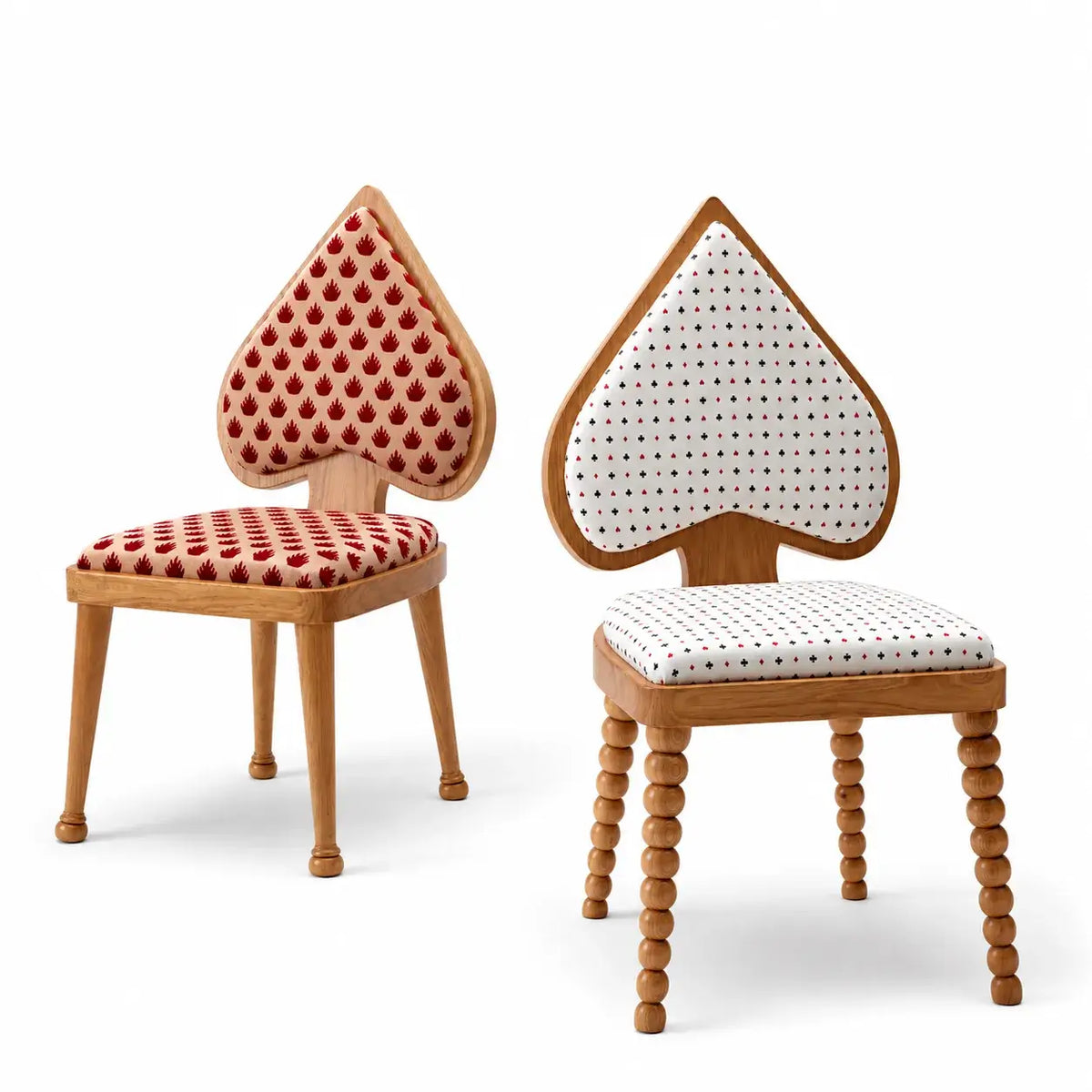
Ash Wood Playing Card Spade Chair
- Solid ash wood frame with visible natural grain
- Sculptural spade-shaped upholstered backrest
- High-density foam cushioning for everyday support
- Choice of tapered or decorative bobbin-turned legs
3.4. A Practical Quality Checklist
- Compare paired turnings for consistent rhythm and clean transitions.
- Check that joints close neatly and remain quiet under gentle pressure.
- View the chair from behind; the frame should look resolved from every angle.
- Test seat depth, back angle, arm height, and cushion recovery together.
- Inspect upholstery alignment where a pattern crosses the seat or back.
- Confirm that the finish is even inside the narrow grooves of the turning.
4. Choosing the Right Bobbin Chair
4.1. Accent, Dining, or Reading Chair?
| Use | Prioritize | Check before choosing |
|---|---|---|
| Accent seating | Distinctive outline and compatibility with nearby furniture | Overall width, sight lines, and viewing angle |
| Dining | Upright support and easy movement | Seat height, arm clearance, and space between chairs |
| Reading | Seat depth, back support, and relaxed arm position | Lighting, side-table reach, and optional foot support |
| Bedroom | Compact scale and a calm relationship with textiles | Door swing, walking path, and visual weight |
4.2. Scale, Seat Height, and Room Proportion
Record overall width, depth, and height, then map the footprint on the floor with removable tape. Include enough space to approach the chair and sit without brushing a wall, table, or curtain. The open frame may look light in a photograph, but wide arms and tall posts still occupy real space.
4.3. Fixed Backs vs. Loose Cushions
A fixed back displays tailored upholstery and keeps its outline with little adjustment. A loose back introduces softness and makes it easier to change the sitting angle. Removable cushions may also simplify routine cleaning, provided their covers and care requirements are clearly understood. In my experience, loose cushions look most intentional when they fit securely between the posts rather than hiding the bobbin frame.
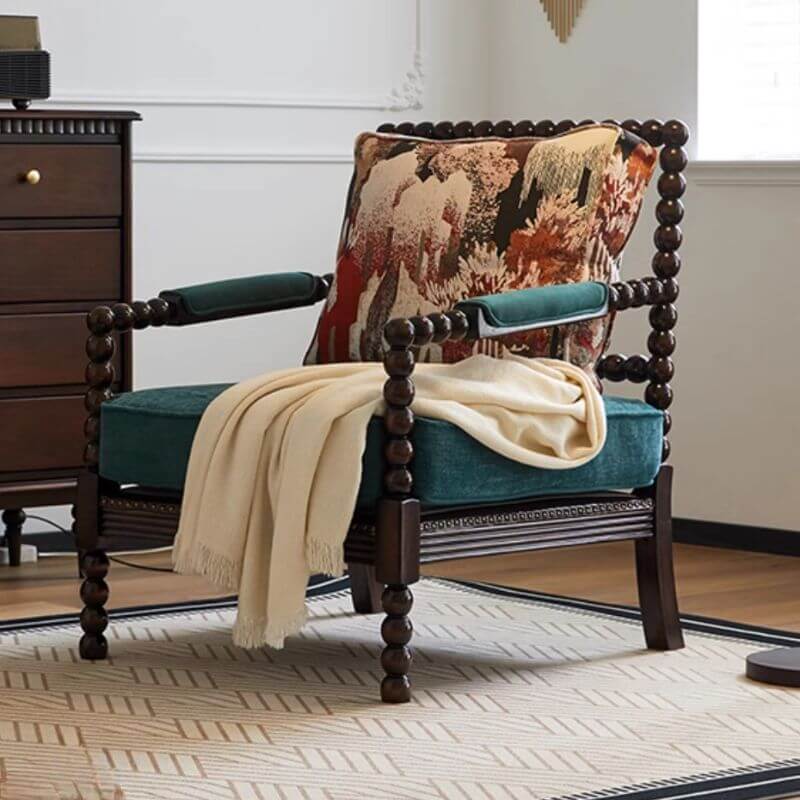
Floral Loose-Back Bobbin Armchair
- Vibrant floral back paired with a deep teal seat
- Loose back cushion for adaptable, relaxed support
- Removable cushions for simpler routine care
- Stable fixed frame suited to reading and conversation
4.4. Patterns, Texture, and Everyday Use
Pattern should clarify the chair, not compete with every detail of its frame. A large floral can turn a broad back into a textile artwork, while a small geometric print gives a sculptural silhouette a more tailored mood. Velvet intensifies color and changes with the direction of its pile; linen-like cloth appears drier and more casual. Consider how the material will look from the doorway as well as close up.
If you are drawn to botanical upholstery, our guide to choosing a floral accent chair explains print scale, silhouette, and room placement in greater depth. Whatever the pattern, ask for care information and consider how sunlight, pets, food, or frequent handling relate to the chair’s intended position.
5. How to Style Bobbin Chairs
5.1. Traditional and Country Interiors
In a traditional setting, natural or dark wood feels at home beside checks, stripes, florals, woven rugs, and aged metal. Charis White’s discussion of bobbin furniture emphasizes vintage examples paired with artisanal textiles, an approach that lets material variation keep the room personal rather than formal.[1] Use one dominant pattern, one quieter companion, and a few solid surfaces so the turned outline remains legible.
5.2. Modern and Eclectic Rooms
For a modern room, contrast is the most reliable tool. Place a bobbin chair beside a low, clean-lined sofa, a monolithic side table, or an abstract artwork. The chair supplies craft and rhythm; the simpler pieces provide visual rest. A pale wood frame feels especially fresh against saturated walls, while a dark frame can outline itself crisply against ivory upholstery and plaster.
5.3. Working with Floral and Velvet Upholstery
Floral upholstery works best when its scale relates to the chair’s broad surfaces. Large motifs suit a tall back, where the repeat has room to breathe. Smaller motifs can animate a dining chair without overwhelming its compact seat. With velvet, use directional light to reveal depth, and balance its richness with matte materials such as wool, unfinished ceramic, parchment, or natural wood.
When floral and velvet appear on the same chair, let nearby furniture become quieter. An ivory sofa, moss wall, restrained rug, and warm metal lamp can support deep red upholstery without competing with it. The goal is not to mute the chair, but to give its color a clear visual role.

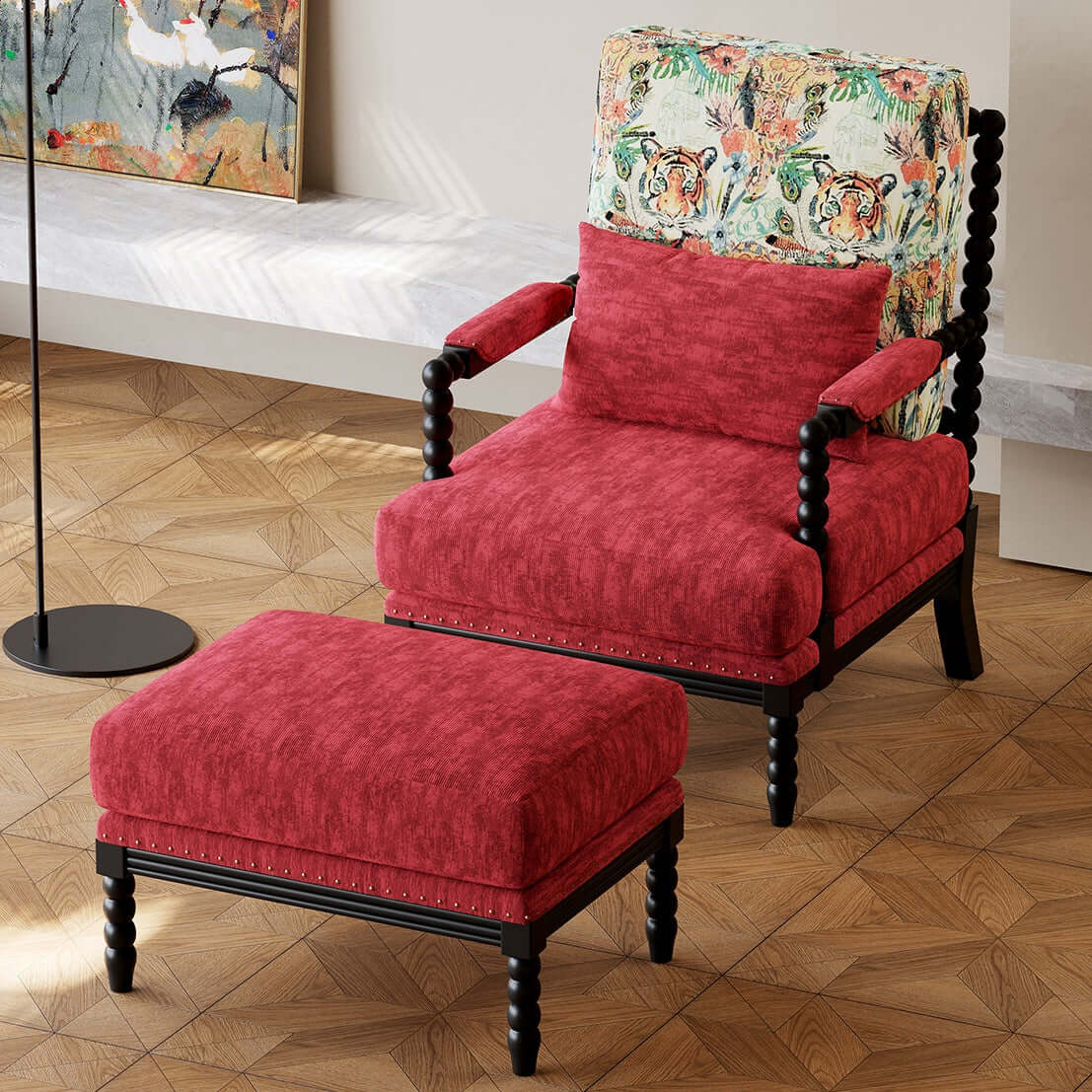
Red Velvet Floral-Back Bobbin Chair
- Deep red velvet upholstery with an inviting soft touch
- Floral and tiger-inspired backrest for artistic contrast
- White ash wood structure with turned frame details
- Coordinating footrest for a more relaxed seating setup
5.4. Color, Rugs, Sofas, and Lighting
- With a neutral sofa: allow the chair to carry the main pattern, then repeat one upholstery color in a cushion or artwork.
- With a patterned sofa: choose a chair pattern of a clearly different scale and connect both through a shared neutral.
- With a rug: avoid placing busy turnings directly over a high-contrast border; a quieter field keeps the outline readable.
- With lighting: use side light to reveal the alternating highlights and shadows of the rounded wood.
- With a side table: select a simple top and confirm it is comfortable to reach from the seated position.
6. Placement and Care
6.1. Living Rooms, Bedrooms, and Reading Corners
A pair of bobbin chairs creates symmetry across a fireplace or opposite a sofa. A single chair is more flexible: it can resolve an empty corner, bridge a transition between rooms, or introduce pattern to a quiet bedroom. Consider the rear view whenever the chair floats away from a wall. Bobbin construction is naturally attractive from behind, and a well-upholstered back deserves to be visible.
Leave visual space around a strong silhouette. A chair with a tall patterned back often needs fewer objects on the wall behind it. A lower open-frame design can sit beneath art without obscuring it. Photograph the room from its main entrance before finalizing placement; the image often reveals crowding or imbalance that is harder to notice while standing inside the arrangement.
6.2. Cleaning Turned Wood and Upholstery
Dust turned wood with a soft, dry cloth, working around each rounded section rather than dragging debris into the narrow grooves. A clean, soft brush can help in detailed recesses. Avoid saturating joints or allowing cleaning liquid to collect between turnings. Follow the maker’s care instructions for the finish, since painted, lacquered, stained, and oiled surfaces do not respond identically.
Vacuum upholstery gently with an appropriate attachment and low suction. Blot spills rather than rubbing them, and test any approved treatment in an inconspicuous area first. For velvet, respect the direction of the pile and avoid aggressive brushing. Removable cushions should still be cleaned according to their specific fabric and filling instructions.
6.3. Protecting Joints, Fabric, and Finish
Lift the chair by its main frame rather than pulling it by a decorative arm or back rail. Check joints periodically for movement, especially on chairs used daily. Protect the upholstery from prolonged direct sun, rotate loose cushions when appropriate, and use floor protection suited to both the leg profile and flooring. These quiet habits preserve the crisp relationship between structure, textile, and finish that makes a bobbin chair distinctive.
FAQ
What is a bobbin chair?
A bobbin chair has repeated rounded forms turned into its wooden legs, arms, rails, or back posts. These bead-like profiles create decorative rhythm while remaining part of the chair’s structure.
Is a bobbin chair the same as a spool chair?
The terms are commonly used interchangeably. Both usually describe furniture with repeated rounded turnings that resemble sewing bobbins or spools, although naming varies by maker and region.
What is the difference between a spindle chair and a bobbin chair?
A spindle chair generally uses multiple slender rods, especially in the back. A bobbin chair is distinguished by more pronounced rounded segments repeated along turned wooden members. Some chairs combine both features.
What kind of sofa looks best with bobbin chairs?
Clean-lined sofas make an effective counterpoint because they allow the detailed chair frame to stand out. Connect the pieces through one shared color, material, or level of formality rather than trying to match them exactly.
Are bobbin chairs comfortable for everyday seating?
They can be, provided the seat depth, back angle, cushion support, and arm height suit the sitter. Test the complete sitting position and choose dining, accent, or lounge proportions for the intended use.
Conclusion
Bobbin chairs endure because their character comes from construction rather than surface decoration alone. Repeated turned rounds give the frame rhythm, shadow, and a sense of craft, yet the open silhouette can remain light enough for contemporary rooms. The most convincing choice begins with use: dining chairs need table clearance and upright support, reading chairs need suitable depth and back comfort, and accent chairs need a scale that strengthens rather than crowds the composition.
Look beyond the first impression of fabric or finish. Follow the turnings into their joints, compare paired elements, test the chair on a level surface, and view it from behind. Then assess the seat, back, and arms as one system. When styling, give the detailed frame contrast and breathing room. Clean-lined sofas, restrained tables, controlled pattern scales, and directional light all help the bobbin profile read clearly. Natural wood can bring warmth and history; dark finishes add graphic definition; floral textiles and velvet can make the chair an expressive centerpiece.
In my experience, a bobbin chair feels most timeless when it is not asked to prove its heritage. Let it participate in the room as useful furniture—comfortable, well placed, and connected to the surrounding colors and materials. With sound proportions, coherent joinery, and upholstery chosen for real life, its distinctive outline can remain engaging through many changes in décor.
References
- Charis White Interiors - A design-led account of bobbin furniture history, turned-wood craft, materials, and textile pairings
- Archive by Dan Mazzarini - An overview of spool furniture, machine-lathe production, the Jenny Lind name, and bobbin chairs
- Apartment Therapy - Designer and educator perspectives on the history and contemporary revival of bobbin furniture

Written by Mia Taylor
Mia Taylor has been exploring the worlds of home design, travel, and fashion since 2022. With a foundation in interior design and hands-on experience in a furniture store, she shares stories and insights that inspire readers while creating a genuine emotional connection.

COCOCHAIRS Programs
At COCOCHAIRS, we craft modern furniture with timeless design and reliable craftsmanship for homes and commercial spaces.
B2B Trade Program: Trade pricing & project support → https://cocochairs.com/pages/b2b
Affiliate Program: Earn 10% per sale, free to join → https://cocochairs.com/pages/affiliate


