
Chinese Benches: Form, Materials and Modern Styling
A Chinese bench can give a room a clear horizontal line without filling it with another large upholstered piece. It might be a spare elm frame in an entryway, a woven seat beside a tea table, or a carved back that becomes the focal point of a sitting area. The appeal lies in those differences: benches can feel quiet, sculptural, decorative, or adaptable while sharing the same basic purpose.
Choosing one starts with the moment you want it to serve. Will someone pause to put on shoes, sit with a guest, or use it occasionally when the room arrangement changes? The answer affects whether a back, arms, a woven surface, or a folding frame makes sense.
I would compare the outline first, then the usable seat and the space around it. This guide brings those checks together with four distinctive designs, material and finish considerations, and ideas for modern and chinoiserie-inspired interiors. The aim is a bench that belongs in the room and works for the way you use it.

1. Four Chinese Bench Designs and What Each Adds
Start by separating the shape of the bench from its surface decoration. A backless seat leaves the wall above it visible. A backed design adds another vertical layer. A folding frame introduces a mechanism that needs its own checks, while a woven seat changes the visual texture within the wooden border.
The comparison illustration below shows general design directions rather than measured drawings of the featured products. Use it to identify the kind of outline you want before looking closely at carving, color, or finish.

1.1. Rectangular Elm Frame for a Quiet Horizontal Line
A rectangular backless bench is a useful starting point when you want the furniture to ground an arrangement without becoming its busiest element. The long plank seat and open lower frame establish a clear line under artwork or beside a hallway wall. Dark wood can provide contrast even when the outline remains simple.
The elm example below combines a dark aged-lacquer effect with a segmented rectangular base and softened seat edges. Its listed lengths range from 47.2 to 78.7 inches, giving you several configurations to compare with a wall or room layout. Check the width and height of the selected version as well; length alone will not establish whether it suits an entry or table.
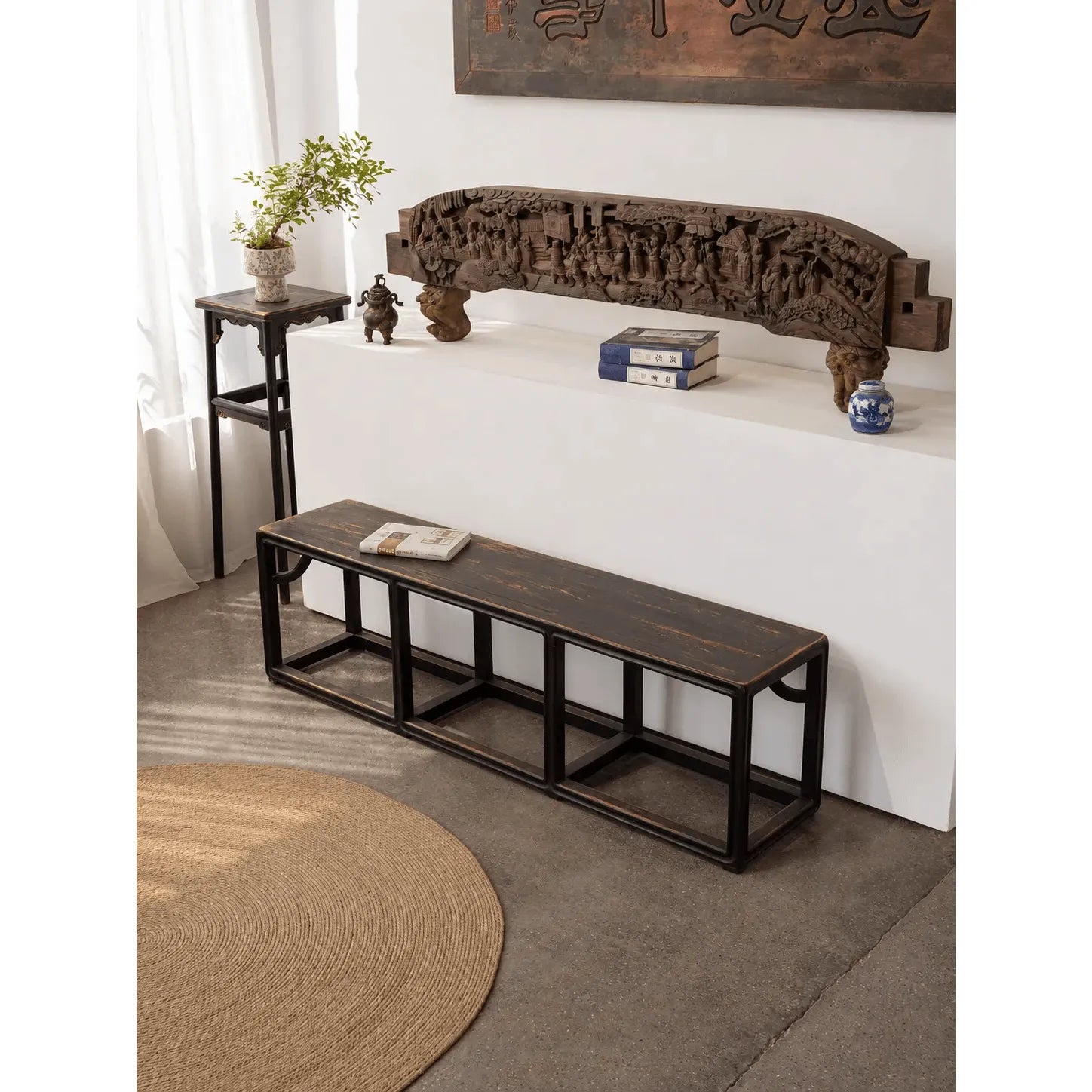
Rectangular Frame Elm Chinese Bench
- Elm wood with a dark aged-lacquer finish
- Backless plank seat and open rectangular frame base
- Five listed lengths from 47.2 to 78.7 inches
1.2. Framed Woven Rattan for Texture and Contrast
A framed woven seat introduces a lighter-looking surface within the dark wood outline. Here, walnut surrounds a honey-toned rattan panel, while the open base repeats the long, low shape. I would keep nearby accessories simple enough for the difference between the border and the weave to remain visible.
This design is listed at 78.7 × 19.7 × 17.7 inches, or 200 × 50 × 45 cm. That substantial length may suit a long wall or a generous sitting area, but it deserves a full floor plan check. Confirm the intended seating capacity and the care instructions for the woven panel rather than assuming that its visual lightness describes its performance.
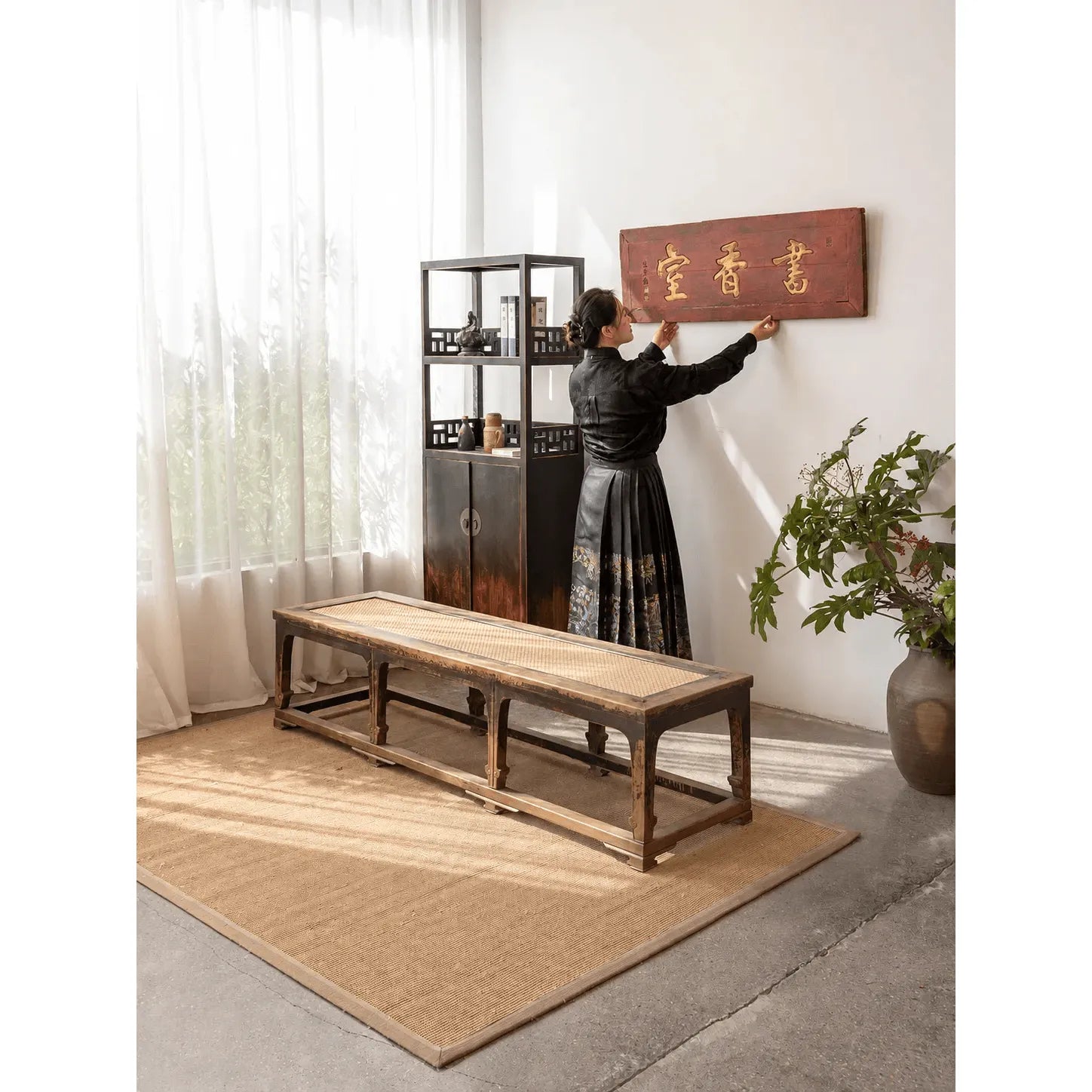
Walnut Chinese Bench with Woven Rattan Seat
- Walnut frame with a natural woven rattan seat
- Open braced base and subtle carved transitions
- Listed dimensions: 78.7 × 19.7 × 17.7 inches (200 × 50 × 45 cm)
1.3. Cross-Leg Folding Frame for a Flexible Arrangement
A folding bench offers a different kind of flexibility from simply choosing a shorter fixed seat. The important questions concern the exact mechanism: how it opens, how it is secured in use, and how much room it needs when stored. Ask for the maker's instructions and both open and folded dimensions.
The featured design has crossing legs, a woven seat, and a shaped backrail with pierced ruyi details. Its wood is described in the listing as sandalwood. The woven seat's fiber is not identified there, so it should be described as woven rather than assumed to be rattan. The contrast between the angled lower frame and the upright back gives it a particularly recognizable profile.
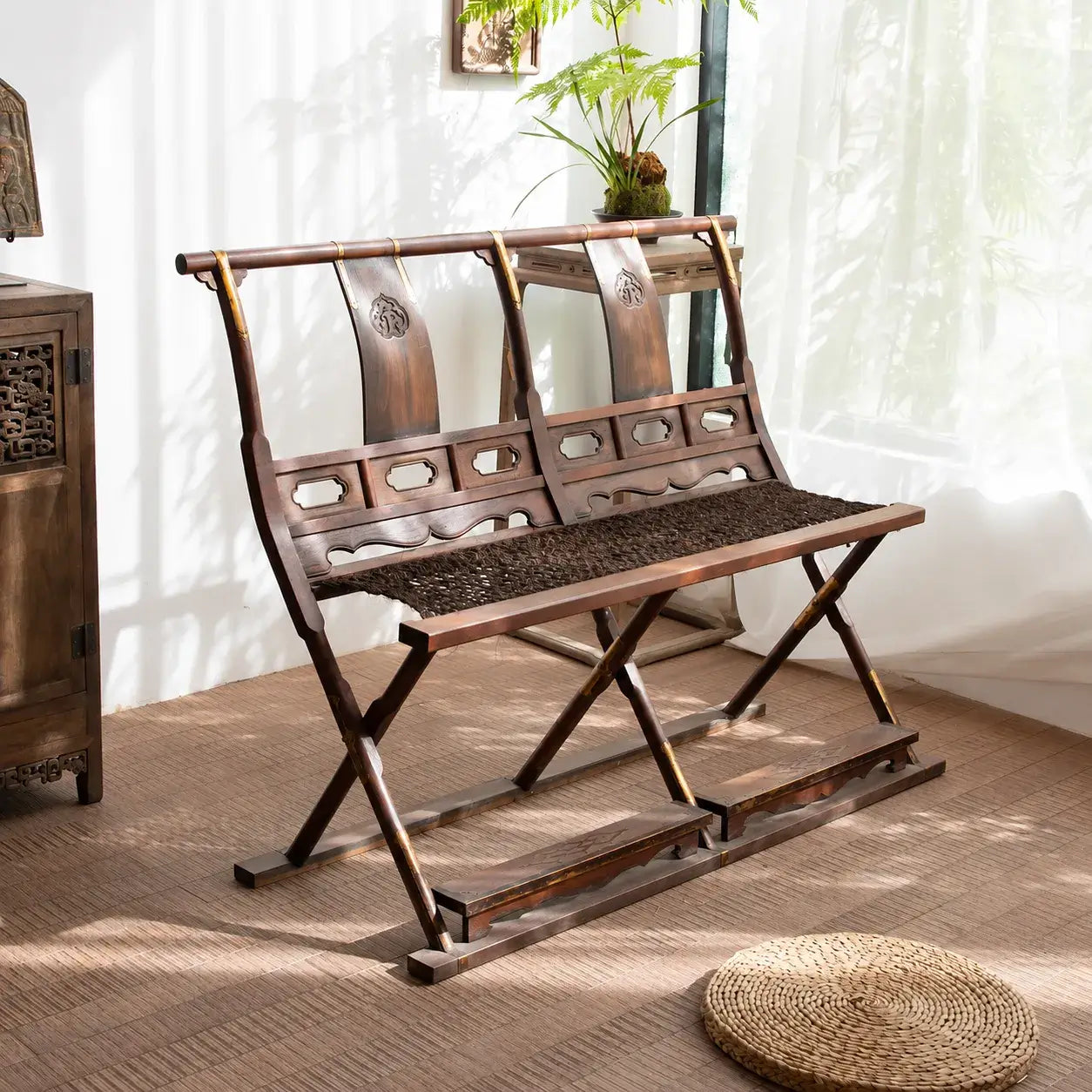
Cross-Leg Folding Chinese Bench
- Cross-leg folding frame with a woven seat
- Shaped backrail with pierced ruyi details
- Deep brown distressed aged-lacquer finish
1.4. Openwork Back and Round Medallion for a Focal Point
A bench with a carved back has a stronger presence above the seat. Openwork means that parts of the design are cut through, leaving spaces between the carved elements. On this example, symmetrical scrolling forms frame a round central medallion, with additional detail at the arms and beneath the seat.
The listing describes the wood as African ebony and the surface as distressed aged lacquer. Request more specific material information if a particular species matters to you. Visually, I would give the back a calm wall and enough viewing distance for its pattern to register. Keep the usable sitting area clear so the bench can remain seating as well as a decorative centerpiece.
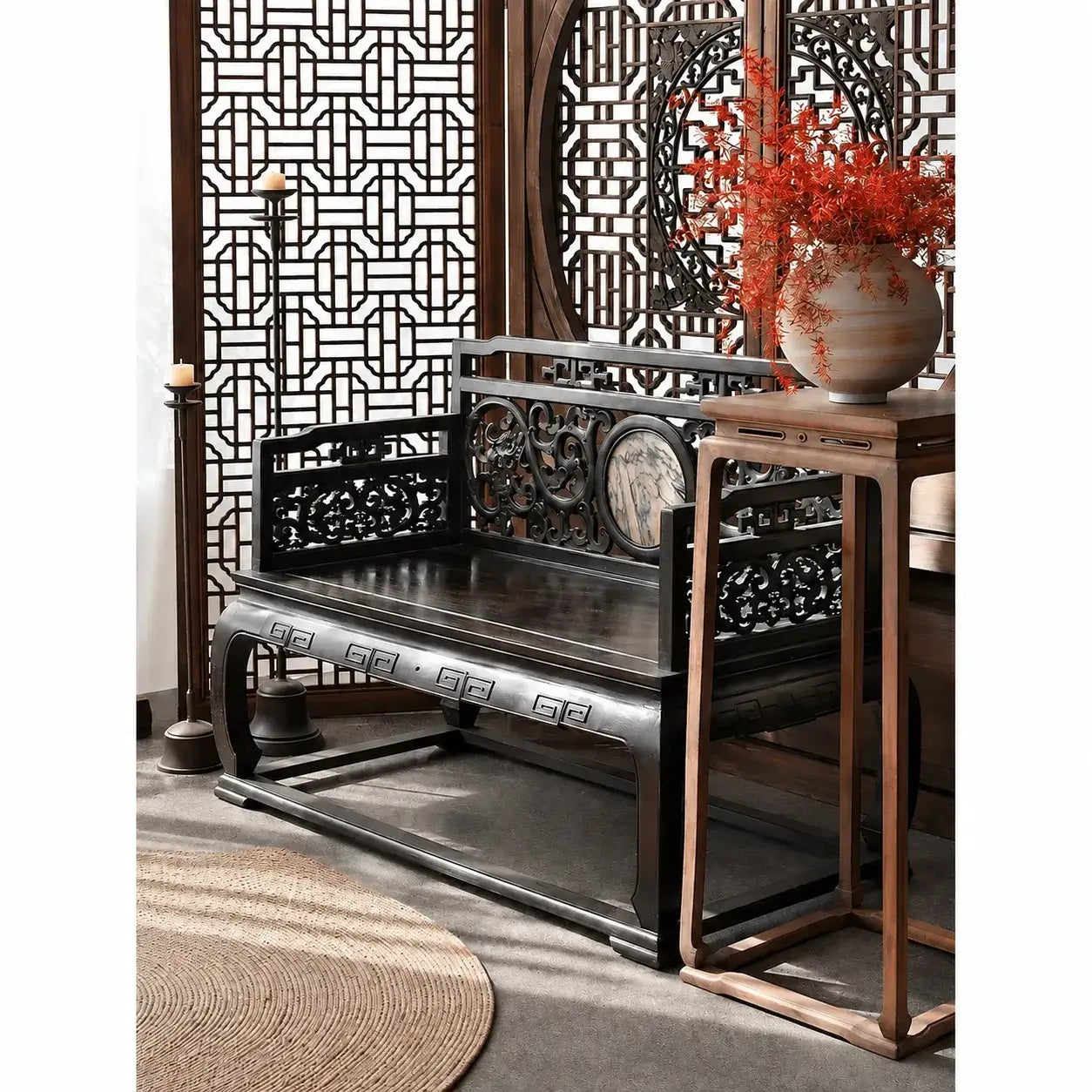
Round Medallion Carved-Back Chinese Bench
- Openwork carved back with a round central medallion
- Broad armrests and a solid plank seat
- Distressed dark finish and geometric key-fret detailing
These four approaches offer a practical shortlist. None establishes comfort, capacity, or room fit by appearance alone; use the next checks to connect the design with its intended role.
| Design | Visual contribution | What to verify |
|---|---|---|
| Rectangular elm frame | A restrained horizontal line | Selected length, seat depth, and height |
| Walnut with woven rattan | Contrast between wood and weave | Full footprint and woven-seat instructions |
| Cross-leg folding frame | An angled base and decorative backrail | Opening method, securing mechanism, and folded size |
| Carved medallion back | A strong decorative center | Usable width inside the arms and space around the back |
2. Choose the Seat for the Way You Will Use It
2.1. Backless or Backed?
A backless bench can keep a room visually open and may be approached from either long side when the frame and placement allow it. Beside a wall, however, it still needs to suit how someone enters and leaves the seat. Avoid treating the wall itself as a designed backrest unless the arrangement is intended for that use.
A backed bench defines a clearer sitting direction. Arms can help frame the arrangement, but they also reduce the space available within the outer width. For conversation seating, compare the inside dimensions and the back position with a chair you already enjoy using. A decorative bench should be assessed for its actual seat, rather than expected to feel like a sofa.
2.2. Look at Usable Space, Not Just Overall Length
Overall length includes structure. On a backed bench, arm supports and carved side panels can occupy part of that measurement. On a woven seat, the wooden border and the panel form different surfaces. Request the usable width and depth, the seat height, and the manufacturer's intended capacity for the exact model.
If the bench will share a sitting area with individual chairs, consider the different sitting positions together. The guide to choosing Chinese chairs by shape and room fit offers a complementary way to assess back, arm, and seat relationships.
Try the task you have in mind where possible: sitting to put on shoes, reaching a nearby table, or standing without moving other furniture. That sequence can reveal a fit issue more clearly than a photograph.
3. Measure the Bench and Its Place in the Room
Measure the furniture and the surrounding activity separately. A bench may fit a wall neatly while leaving too little room to sit down in front of it. Tape out the widest footprint, including projecting arms, backrails, or feet, then add the nearby door, table, and route through the room.
- Seat height: floor to the sitting surface, accounting for any intended cushion.
- Usable width and depth: the sitting area inside arms, back supports, and substantial borders.
- Overall length and depth: the full outer footprint, including projections.
- Approach and circulation: space to reach the seat, stand up, and pass while it is occupied.
- Folding clearance: the exact open and folded sizes and the space needed to operate the mechanism.
The measuring illustration uses arrows and labels without numerical rules. It distinguishes the sitting area from the outside footprint and adds door swing and circulation to the room plan. A product's dimensions and operating instructions should determine the final layout.

3.1. Entryways and Hallways
In an entryway, check the main door through its opening arc and consider what happens when someone is seated. Bags, coats, shoes, and a person bending forward all change the space in use. A long bench can look disciplined against the wall while still interrupting an everyday route.
I would also check nearby cabinet doors and drawers before settling on the position. Keep the bench's purpose clear: if it is a place to sit, leave the sitting surface available rather than filling it with decorative objects.
3.2. Tea Spaces, Living Rooms and Bed Ends
Beside a tea table, compare seat height with the table and test the reach. In a living room, make sure a backed bench faces the conversation area rather than turning its most decorative side away from the room. At a bed end, check the passage around the bed and any drawers that need to open.
Finally, measure the delivery route. The room may accommodate a bench that cannot easily pass a stair turn or doorway. Confirm which parts, if any, arrive assembled; a long fixed frame and a folding model may need different handling plans.
4. Read Wood, Weaving and Aged Finishes Carefully
4.1. Ask What Each Component Is Made From
Read the frame, seat, and decorative details as separate components. The featured designs list elm, walnut, sandalwood, and African ebony, but these names do not all offer the same level of botanical specificity. Ask for further identification when material origin or species is central to your selection.
The walnut model explicitly identifies a natural rattan seat. The folding model describes its seat as woven without naming the fiber. Preserve that distinction when comparing them. Similarly, a photograph of visible joints cannot confirm the construction of every connection; request the maker's details instead of inferring a joinery method from the style.
4.2. Distinguish an Aged Look from Documented Age
Dark lacquer, worn-looking edges, and a replica-style description help explain the visual effect. They do not establish when a bench was made. Choose the finish because its color and surface suit the room; assess an antique claim separately through documentation and provenance.
Look at the actual product images in more than one view. On a simple bench, the relation between the seat and base may carry most of the design. On a carved bench, examine the back, side panels, and lower apron as well as the central detail.
4.3. Care for the Materials and Finish Together
Furniture can combine several materials with different care needs. The Australian Institute for the Conservation of Cultural Material recommends identifying those materials and using gentle dusting, including fine brushes for intricate areas.[1] Follow the maker's instructions for the particular coating and woven surface.
Light, humidity changes, and nearby heat can affect wooden furniture. The Canadian Conservation Institute advises avoiding direct sunlight and heat sources and cautions that some polishes leave residues.[2] A sheltered indoor position and an appropriate cleaning routine are worth considering alongside appearance.
5. Style a Chinese Bench in a Modern or Chinoiserie-Inspired Room
5.1. Start with the Bench's Strongest Feature
Choose one quality to lead: the long line of dark elm, the lighter rattan panel, the folding frame's diagonal legs, or the carved medallion back. Then let the surrounding room support it. For the simple plank bench, one substantial artwork can be enough. For the rattan design, nearby plain textiles can leave the weave visible.
A backed bench generally asks for a different wall arrangement from a backless one. Before adding artwork, look at the height of the back and how the outline meets the wall. I would leave a carved back clear of low-hanging objects that compete with its pattern.
5.2. Use Chinoiserie as a Styling Context
Chinoiserie has a particular decorative history. The V&A describes an eighteenth-century style inspired by Asian art and design, often shaped by European designers' imagination.[3] The term is useful for discussing a room's decorative language, while Chinese furniture remains a broader subject.
A Chinese bench can sit comfortably within a chinoiserie-inspired arrangement without every detail being repeated. Try a restrained patterned accent, blue-and-white ceramics, or one botanical artwork, then leave a quiet surface around the bench. Treat these as styling choices rather than evidence of the bench's origin or age.

With the carved example, let the round medallion be the main visual center. An object placed well to one side can balance the composition without hiding the back. Keep the seat clear and the nearby table far enough away to enter and leave the bench comfortably.
FAQ
Should I choose a Chinese bench with or without a back?
Choose according to the sitting task and the room layout. A backless bench keeps the wall visible, while a backed design sets a clearer sitting direction. Compare the actual seat and back position before deciding.
How many people can sit on a Chinese bench?
Check the manufacturer's intended capacity and usable sitting width for the exact model. Overall length alone does not establish either the number of users or the load capacity.
What should I check before choosing a folding Chinese bench?
Request its open and folded dimensions, the opening and securing instructions, and the clearance needed to operate it. Confirm that the intended storage position and delivery route suit the exact model.
Does an aged-lacquer finish mean a bench is antique?
An aged-lacquer or distressed description explains appearance or treatment, not a production date. An antique claim needs separate documentation about age and provenance.
Can a Chinese bench work in a chinoiserie-inspired room?
Yes. Use the bench as part of the room's decorative arrangement, with selected patterned accents or ceramics and enough quiet space around it. Chinoiserie describes a decorative style; it does not establish the bench's origin or age.
Conclusion
The right Chinese bench brings together a useful seat, a clear shape, and an appropriate place in the room. Begin with the role it will serve, then compare the designs through that purpose. A rectangular elm frame can provide a restrained horizontal line. A woven rattan seat introduces a different texture, while a folding frame offers a mechanism to consider and a carved back gives the arrangement a stronger decorative center.
Check the information that an attractive image cannot settle. Overall length, usable seat width, depth, height, and intended capacity answer different questions. So do the footprint of a fixed bench and the open and folded dimensions of a folding design. Include the people using the space, the doors around it, and the route through the room when you make the final plan.
Read material and finish descriptions with the same attention. Identify what belongs to the frame, what forms the sitting surface, and what care each component needs. Distinguish a deliberately aged appearance from documented antique age, and let the bench's best feature guide the styling. Whether the room is spare and contemporary or layered with chinoiserie-inspired accents, a thoughtful arrangement gives the wood, weave, or carving enough space to be appreciated while keeping the bench ready for use.
References
- [1] Australian Institute for the Conservation of Cultural Material — Wood and furniture: materials, dusting, and conservation considerations.
- [2] Canadian Conservation Institute — Basic care of wooden furniture: light, humidity, handling, and finishes.
- [3] Victoria and Albert Museum — Chinoiserie: the decorative style and its sources of inspiration.

Written by Mia Taylor
Mia Taylor has been exploring the worlds of home design, travel, and fashion since 2022. With a foundation in interior design and hands-on experience in a furniture store, she shares stories and insights that inspire readers while creating a genuine emotional connection.

COCOCHAIRS Programs
At COCOCHAIRS, we craft modern furniture with timeless design and reliable craftsmanship for homes and commercial spaces.
B2B Trade Program: Trade pricing & project support → https://cocochairs.com/pages/b2b
Affiliate Program: Earn 10% per sale, free to join → https://cocochairs.com/pages/affiliate


